

PulseGrid is being built to monitor the health of your physical security ecosystem — from cameras and recording servers to storage, switches, UPS systems and environmental conditions — so developing issues surface before they become outages.
 pulsegrid · all devices
LIVE
pulsegrid · all devices
LIVE
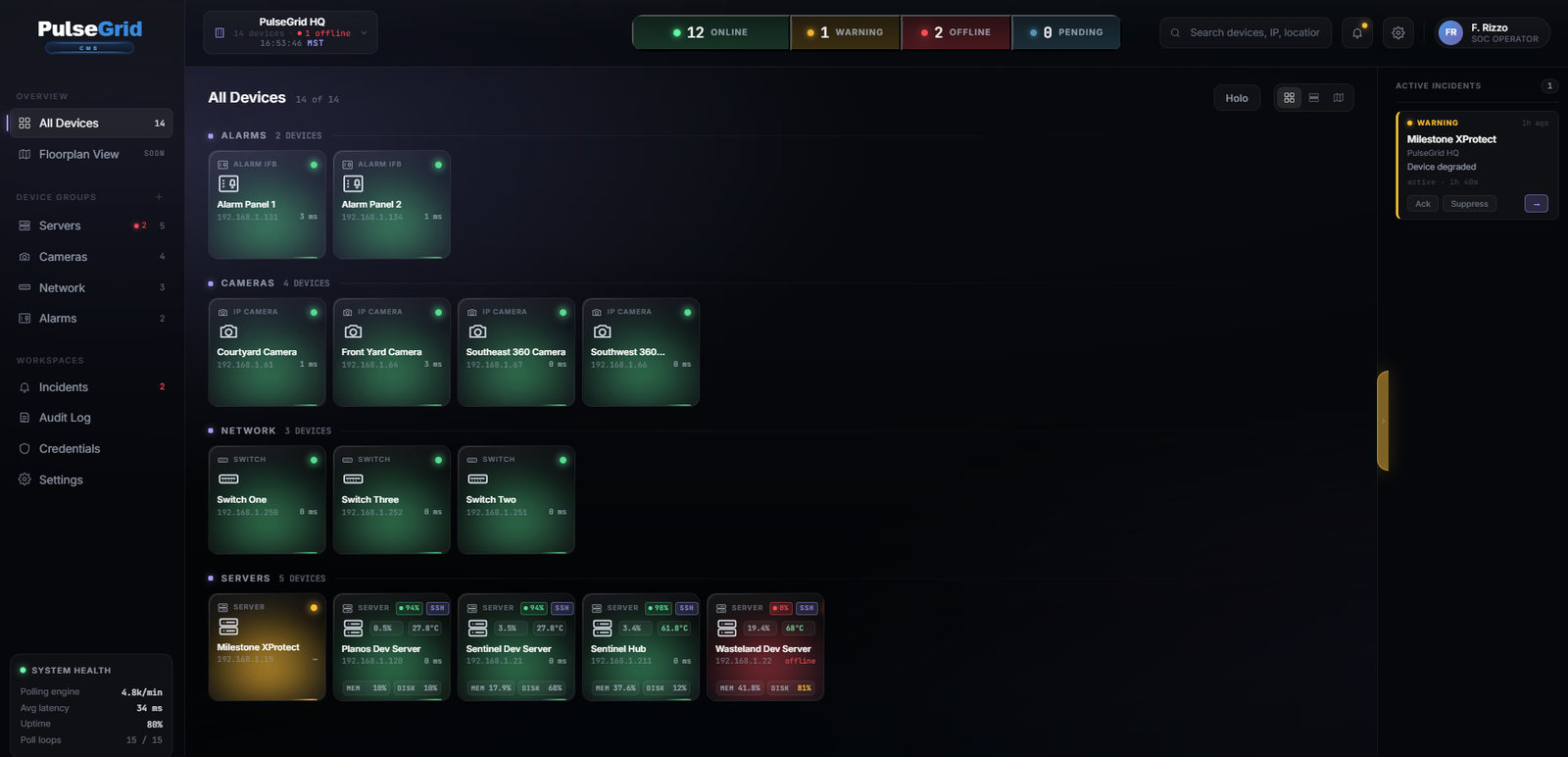
PulseGrid is in active development. This page describes the product direction and the capabilities currently being built and tested — it is not a shipping feature list. Items marked Planned are not yet implemented.
Storage fills. SSD health declines. Temperatures climb. UPS batteries age. Switches run out of PoE budget. Recording servers quietly run short on resources. None of it trips an alarm — until the night you need footage and it isn't there.
That is what PulseGrid is being built to watch. Watchtower watches the video; PulseGrid is designed to watch what sits behind the video — the hardware, storage, network and environment your security depends on.
Instead of watching video, PulseGrid is designed to watch what the video depends on — so you catch trouble before darkness, not after.
Not generic IT monitoring. PulseGrid is being built around the devices a security operation actually runs on, and the failures that matter on each. Capability depth varies by device class — see the Planned notes below.
Camera connectivity, availability and operational state — surfaced when a device drops.
PlannedFirmware telemetry · sensor temperature · onboard storage health
The machines Watchtower runs on — from load to recording pipeline health.
In developmentService-level and recording-pipeline checks are still being built out
Drive-level visibility for the vault your footage lives in — so a failing disk surfaces before it takes the retention with it.
PlannedRAID array health · throughput/performance metrics
The switches and links every device depends on, on an SNMP monitoring foundation — with expanded switch, PoE, interface and vendor-specific telemetry planned.
PlannedExpanded switch, interface & vendor-specific SNMP telemetry
The room itself — an environmental monitoring architecture for temperature, humidity, power and UPS conditions, because heat and power loss take down hardware every other check calls healthy.
PlannedExpanded direct-sensor integrations
Bring multiple locations into a single interface, with each site's health at a glance.
PlannedValidated large-fleet and cross-site rollups
PulseGrid is being built to evaluate health telemetry and surface developing problems — a wearing SSD, a climbing drive temperature, a service starting to slip — while there is still time to act.
pulsegrid · device healthLIVE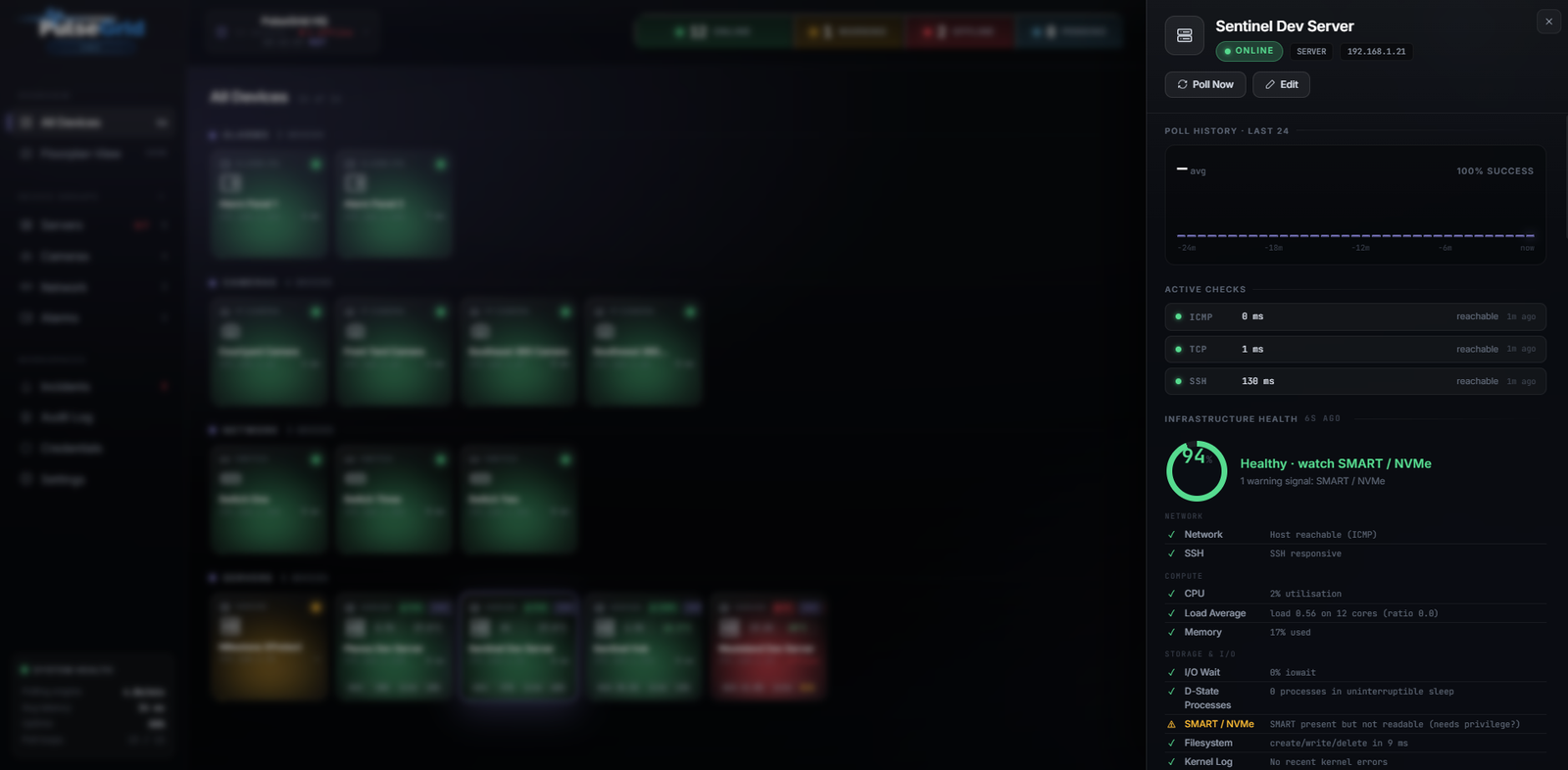
Health scores are designed to summarize wider device condition while critical findings stay independently visible. Scoring is still being tuned against real hardware.
PulseGrid is being built to group related signals into actionable incidents — acknowledge, suppress, resolve — so an operator can see what actually needs attention rather than a wall of statistics.
pulsegrid · incidentsLIVE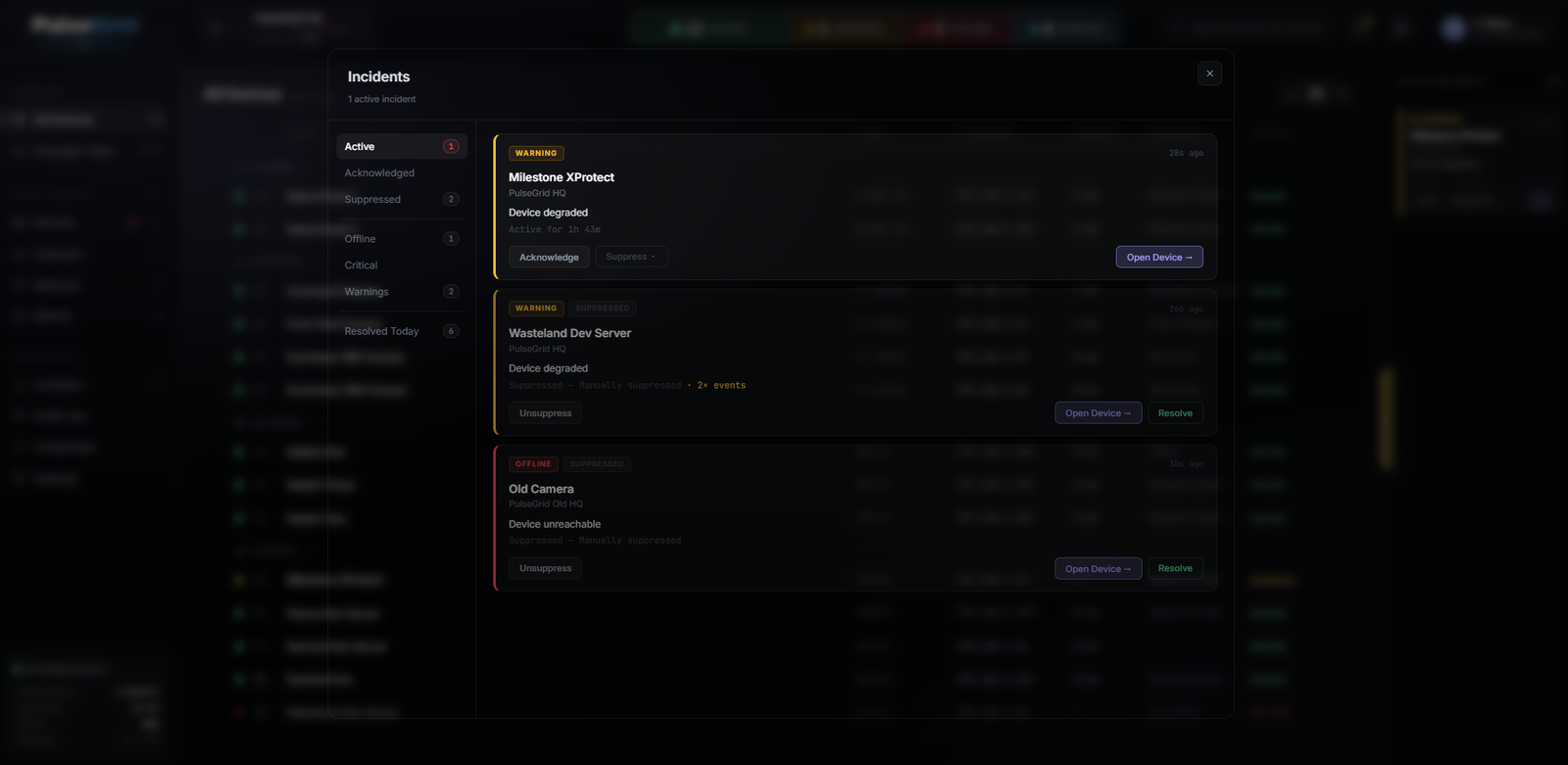
Sites on one map, showing their current health, with devices reachable from the point they sit on.
pulsegrid · map viewLIVE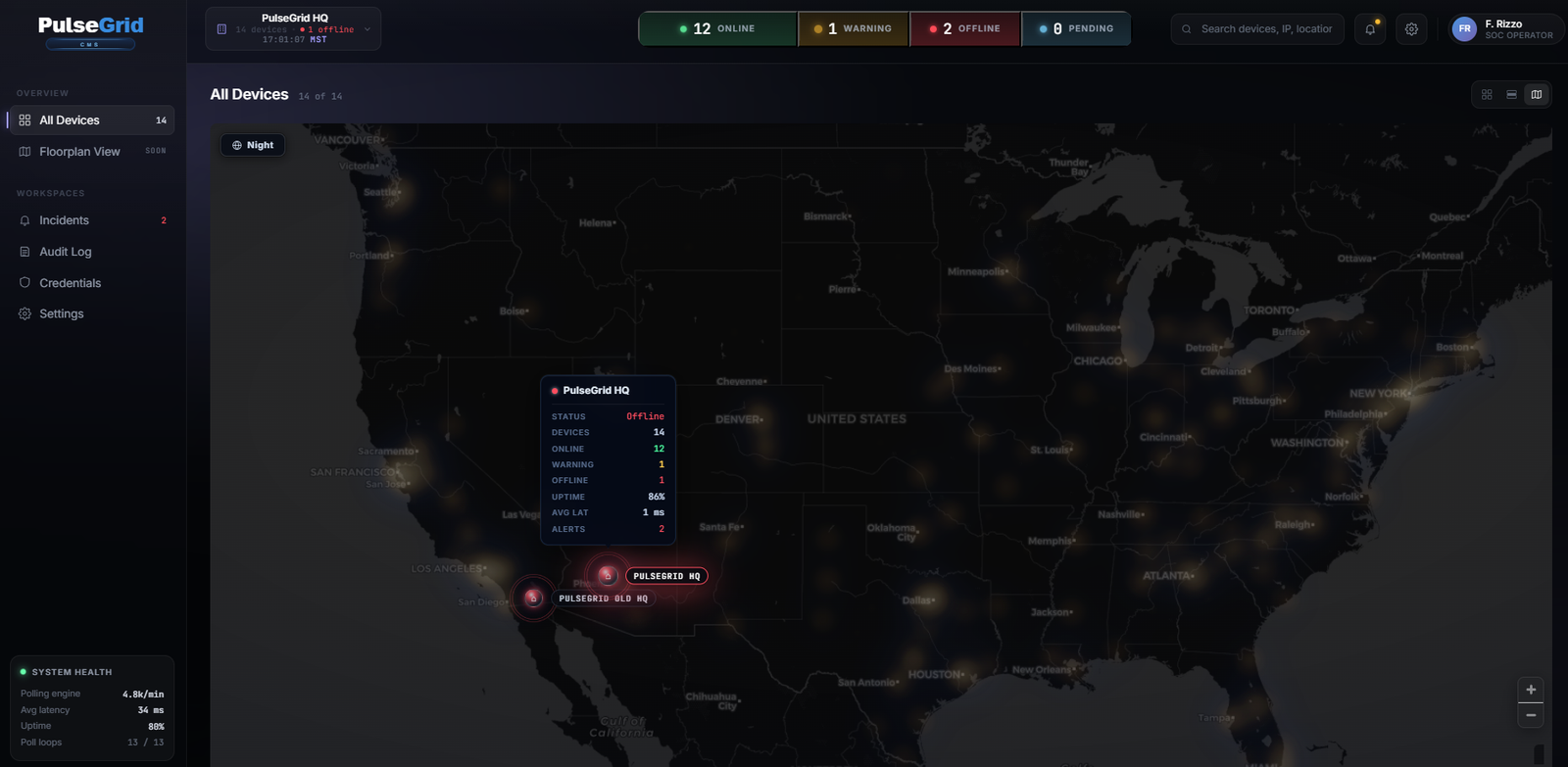
Each site carries its own status, uptime and open alerts.
Markers pulse with live state — calm when healthy, urgent when not.
Online, warning and offline, rolled up per location.
Jump straight from the map into any device.
PulseGrid is being designed to run on your own network — no mandatory cloud dependency, no forced subscription — keeping the operational telemetry that describes your security posture under your control.
A look at what's planned. These are directions we're building toward — not features shipping today.
Deeper per-camera signals — firmware, sensor temperature and on-board storage.
Richer switch, router and UPS telemetry through expanded SNMP support.
Direct integration with temperature, humidity and power sensors in the rack.
Trend-based forecasting to estimate time-to-failure from developing signals.
Scheduled health and uptime reporting for stakeholders and compliance.
Larger fleets and richer cross-site rollups through one console.
PulseGrid doesn't compete with Watchtower — it complements it. Each product addresses one layer of the same security operation. They share a philosophy and direction; they are not yet marketed as one integrated suite.
 WatchtowerVideo management
Live monitoring, recording, playback and investigations — the flagship VMS.
See it →
PulseGridInfrastructure health monitoringThe health of the hardware, storage, network and environment behind the video.
You are here SentinelHome Security Control
Modern, local control of the alarm system on the wiring and sensors you already own.
Protect it →Watchtower manages the video. PulseGrid watches the infrastructure behind it. Sentinel modernizes and controls the home security system. Together they form the Zoneary ecosystem — local-first, owned, not rented.
PulseGrid is in active development. Request early access and we'll bring you in as it rolls out to the Zoneary ecosystem.